

Do Bernedoodles Shed? A Breeder’s Guide to Coats, Furnishings & Grooming
One of the questions I hear most often from families considering a Bernedoodle is:
“Do Bernedoodles shed?”
The answer isn't as simple as yes or no.
Bernedoodles can be very low shedding, but I don't believe any breeder should promise that every Bernedoodle will be completely shed-free.
One reason is simple: a Bernedoodle comes from two very different parent breeds.
The Poodle is known for its furnished, low-shedding coat. The Bernese Mountain Dog is a shedding, non-furnished breed.
When we combine those genetics, Bernedoodle coats can vary—even among puppies in the same litter.
Understanding furnishings, coat type, generation and the genetics of the individual parents gives families a much better idea of what to expect.
Why Some Bernedoodles Shed More Than Others
A Bernedoodle isn't a standardized purebred dog with one predictable coat.
Every puppy inherits a combination of genes from its parents.
That's why one Bernedoodle may have a plush, wavy coat and lose very little hair while another has a straighter coat and sheds more noticeably.
Generation labels such as F1, F1b or multigenerational can provide information about a puppy's ancestry, but I don't think families should choose a puppy based on the generation label alone.
The genetics of the actual parents and puppy matter.
At O'Hearon's Amazing Puppies, coat genetics are one of the things we consider when planning our pairings and evaluating puppies.
What Are Furnishings in a Bernedoodle?
“Furnishings” refers to the characteristic longer facial hair seen around a dog's muzzle and eyebrows.
It's one of the visible differences between the classic fluffy doodle face and the smoother face of an unfurnished dog.
Bernese Mountain Dogs are naturally unfurnished.
Poodles are furnished.
Bernedoodles can therefore inherit different furnishing genetics depending on the pairing.
Furnishings can also be relevant when we're evaluating expected coat characteristics and shedding, although they aren't the only genetic factor involved.
This is why I prefer looking at actual genetic results rather than making assumptions based only on what a puppy looks like at a few weeks old.
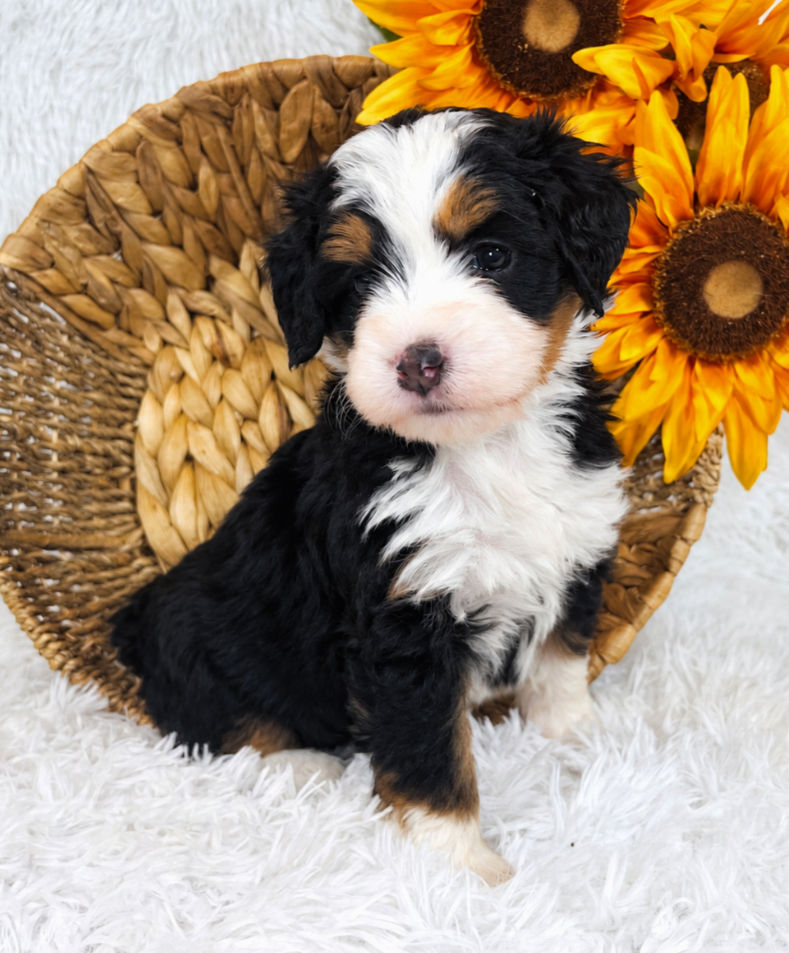
Straight, Wavy and Curly Bernedoodle Coats
Bernedoodles can have a range of coat textures.
Straight coats
A straight-coated Bernedoodle can retain more of the natural look associated with the Bernese side.
Straight doesn't automatically mean “heavy shedding,” and it doesn't automatically mean unfurnished.
Those are separate characteristics.
Wavy coats
Wavy coats are extremely popular because they can give families that soft, relaxed Bernedoodle appearance without being as tightly curled as some Poodle-influenced coats.
Curly coats
Curly coats generally show more obvious Poodle influence.
But again, curl alone isn't enough to tell you everything about shedding.
That's why I don't like reducing Bernedoodle coats to:
“Curly = doesn't shed” and “straight = sheds.”
Genetics are more complicated than that.
Are Bernedoodles Hypoallergenic?
I would be cautious anytime someone guarantees that a dog is hypoallergenic.
No dog can be guaranteed to cause no allergic response in every person.
People can react to more than loose hair, including proteins found in dander and saliva.
A low-shedding coat may be easier for some families to live with, but low shedding and hypoallergenic are not interchangeable promises.
If someone in your household has significant dog allergies, I recommend discussing that honestly before choosing a puppy rather than assuming that the word “Bernedoodle” automatically solves the problem.
Does Bernedoodle Generation Determine Shedding?
Generation can give us useful information, but I wouldn't use it as the only predictor.
You may see terms such as:
F1 Bernedoodle
F1b Bernedoodle
Multigenerational Bernedoodle
Those labels describe ancestry or breeding structure.
They do not replace genetic testing.
Two puppies carrying the same general generation label can still inherit different coat characteristics.
For me, the better question isn't simply:
“What generation is this puppy?”
It's:
“What do we know about the parents and the puppy's coat genetics?”
Can Puppies From the Same Litter Have Different Coats?
Yes.
Littermates don't receive identical combinations of genes from their parents.
One puppy may develop a straighter coat while another is noticeably wavier. Furnishings, curl, color, markings, size and other characteristics can vary as well.
That's one reason I evaluate puppies individually.
A family shouldn't assume that every puppy in a litter will grow up with exactly the same coat simply because they share the same parents.
Low-Shedding Does Not Mean Low-Maintenance
This is something I really want future Bernedoodle families to understand.
A dog that drops less hair around your house may actually require more hands-on coat maintenance.
Bernedoodle coats can mat if they're not brushed and combed thoroughly.
Families should be prepared for regular brushing and combing, attention to friction areas such as behind the ears and around the legs, routine bathing and drying, nail care, and professional grooming on an appropriate schedule.
Simply running a brush across the top of a fluffy coat isn't always enough.
A metal comb is especially useful for checking whether you've actually reached through the coat.
I've included many of the grooming products and tools I recommend to our families on our Puppy Essentials page.
What Should You Ask a Breeder About Coat and Shedding?
If shedding is important to you, tell your breeder.
I would ask:
What are the coat genetics of the parents?
Are the puppies furnished?
What coat textures are expected from this pairing?
What have previous puppies from these lines looked like as adults?
How much shedding should I realistically expect?
And perhaps most importantly:
What can't the breeder guarantee?
I respect realistic expectations much more than absolute promises.
How We Approach Bernedoodle Coats at OAP
At O'Hearon's Amazing Puppies, appearance matters—but it isn't our only consideration.
When planning a pairing, we're looking at the whole dog: health, temperament, structure, genetics, size, coat characteristics and the traits we hope to preserve or improve.
We also want families to understand what they're choosing.
If you love a particular coat texture or need the lowest-shedding option available within a litter, tell us.
Those preferences can become part of the conversation when we're helping you evaluate puppies.
But I will always be honest that no living animal comes with a guarantee that it will never shed a hair.
For many of our low-shedding Bernedoodles, families may see very little loose hair—perhaps an occasional hair here and there—but realistic expectations matter.
Choosing the Right Bernedoodle Coat for Your Family
There isn't one “best” Bernedoodle coat.
The right coat depends on what matters to your family.
Some people adore a straighter, more Bernese-looking coat.
Others love a soft wave.
Some prioritize the lowest possible shedding.
Others care more about temperament, size or traditional markings.
I encourage families not to choose a puppy based on one trait alone.
Health, temperament and lifestyle fit should always remain part of the decision.
If you're still learning about the breed, read What Should I Know Before Getting a Bernedoodle? for a broader look at size, temperament, health testing, socialization and what puppy ownership really involves.
Looking for a Bernedoodle Puppy in Utah?
O'Hearon's Amazing Puppies is a family-based Bernedoodle breeding program in Saratoga Springs, Utah.
If you're looking for a particular coat, size, color or temperament, you can explore our Available Bernedoodle Puppies or see what we're planning on our Upcoming Litters page.
When you're ready to tell us what you're looking for, complete our Puppy Application.
We'd much rather help you understand what's realistically possible than promise you something genetics can't guarantee.


Comments